
[ Shopify ]
How Much Does a Shopify Website Cost in Australia?
A Shopify website in Australia has two kinds of cost: what you pay Shopify and app makers every month, and what you pay to have the store designed and built. Here’s how each one works.
We build the funnels, stores and CRMs we write about — this isn't outsourced content.

Short answer: the cost of a Shopify website in Australia is made up of a monthly Shopify plan, payment processing on each sale, any paid theme and apps, and the one-off cost of designing and building the store. The plan is usually the smallest part. What changes the total most is how custom the design is, how many products and integrations you need, and how many paid apps you add.
This guide breaks down each cost so you can build a realistic budget. We don’t publish our own prices — every store is different — but we’ll show you what to ask for in any quote. Selling in India too? See our Shopify store cost in India guide.
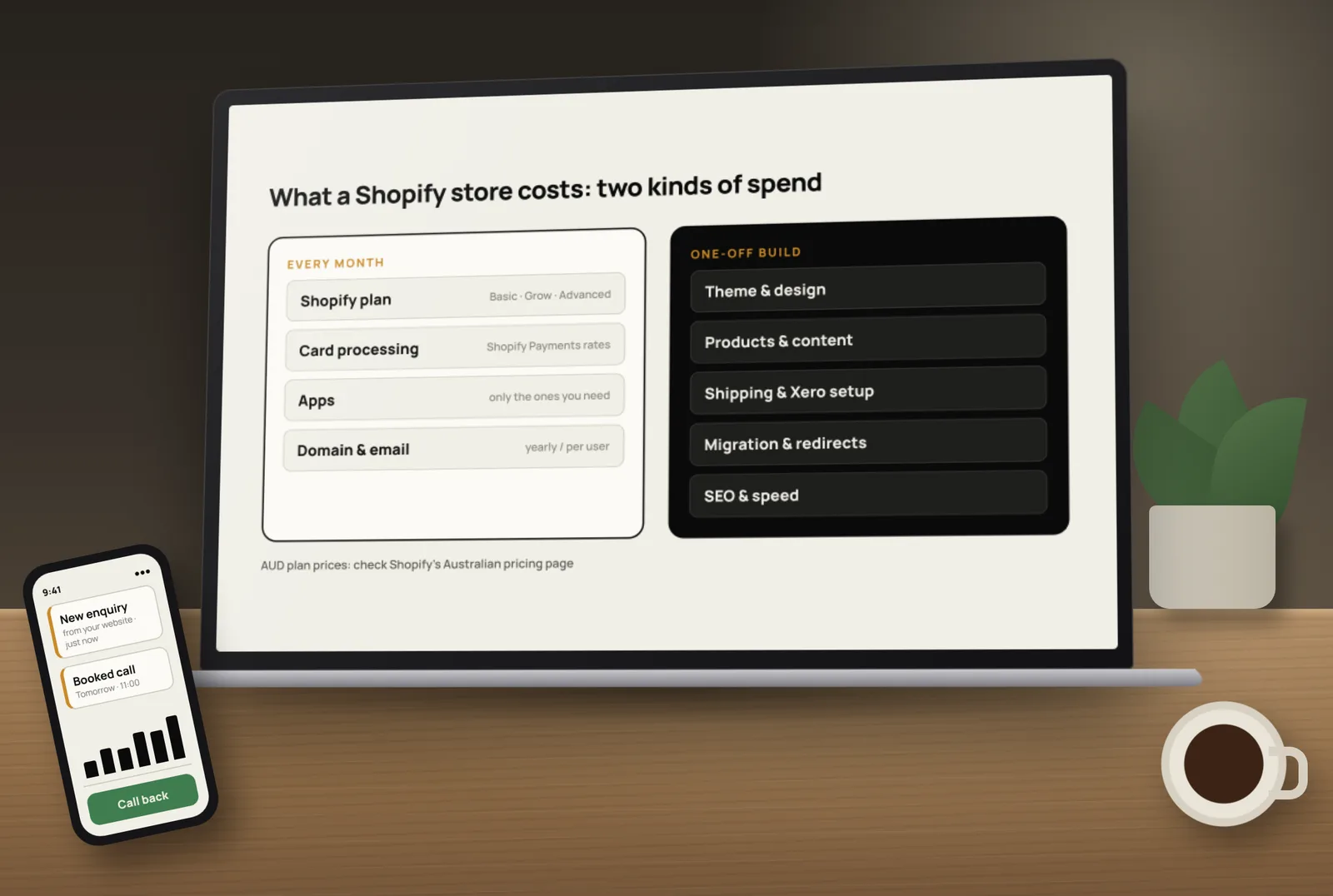
Ongoing costs: what you pay every month
1. Your Shopify plan
Shopify’s main plans are Basic, Grow and Advanced, with Shopify Plus for large brands. Shopify’s pricing overview explains that annual billing costs less per month but is paid upfront. Current prices in Australian dollars are on Shopify’s Australian pricing page — check there, as prices and offers change.
2. Payment processing
Australia is on Shopify’s list of Shopify Payments countries. With Shopify Payments, you pay card processing rates set by your plan. If you use an outside provider instead, Shopify adds a plan-based third-party transaction fee on top of that provider’s own charges — one reason most Australian stores use Shopify Payments.
3. Apps
Apps add features such as reviews, email marketing, shipping labels, buy now pay later and accounting sync. Many have free plans; paid ones usually bill monthly. A typical small store needs only a handful — our list of Shopify apps for Australian businesses covers the common ones.
4. Domain and email
A .com.au or .com domain renews yearly. Business email (for example through Google Workspace or Microsoft 365) is a separate monthly cost per user.
One-off costs: designing and building the store
This is where quotes vary most. What drives the price:
- Theme — a free Shopify theme, a paid theme from the Theme Store (a one-off purchase), or a custom design.
- Design work — adapting a theme to your brand is quicker than designing every page from scratch.
- Number of products and variants — and whether someone needs to load and tidy them.
- Content — product descriptions, photos and page copy. Who writes and shoots them?
- Integrations — shipping (Australia Post, couriers), accounting, inventory, ERP or POS.
- Custom features — product builders, subscriptions, B2B pricing, bundles.
- Migration — moving products, customers, orders and redirects from an old site; see how to migrate a website to Shopify.
- SEO and speed setup — titles, structured data, image optimisation and redirects.
Three typical Shopify builds
Starter store
A free or paid theme set up with your branding, a small catalogue, essential apps and payments, shipping and tax settings done properly. Best for new brands testing products.
Growing brand
A theme heavily customised to your brand, more products and collections, email marketing, reviews, buy now pay later, shipping and accounting integrations, and SEO groundwork.
Custom or high-volume store
A custom design, complex product options, integrations with stock or ERP systems, B2B or wholesale features, and possibly Shopify Plus.
Costs Australian store owners often forget
- App creep — small monthly apps add up. Review them every quarter.
- Product photography — good photos sell; budget for them.
- Marketing — a store needs traffic: SEO, Google and Meta ads, email.
- Ongoing changes — new collections, seasonal banners, fixes after app updates.
- Accounting and tax advice — speak to your accountant about GST and how to record Shopify income and fees.
What a good Shopify quote should include
- Which theme, and how much design customisation.
- The pages and templates included.
- How many products will be loaded, and by whom.
- Which apps and integrations will be set up.
- Payments, shipping and tax configuration.
- SEO setup and redirects if you’re moving from another site.
- Testing, launch and training.
- Support after launch, and how changes are charged.
How to keep Shopify costs under control
- Start with a good theme and customise it, rather than a full custom design.
- Use Shopify’s built-in features before adding apps.
- Pay yearly for your plan once you’re sure Shopify is right.
- Launch with the essentials and add features based on real customer data.
- Keep speed in mind — fewer apps usually means a faster store; see our Shopify speed optimisation checklist.
Want a clear quote for your store? Tocal works with Australian businesses as a remote team, with fast delivery and reasonable pricing. See our Shopify developers for Australia page, or our main Shopify service. Book a free call and we’ll scope your store in plain English.
Frequently asked questions
It depends on your plan, payment processing, paid theme and apps, and how much design and setup work you need. The monthly plan is usually the smallest part; the build and apps vary most. Check Shopify’s Australian pricing page for current plan prices.
Shopify’s main plans are Basic, Grow and Advanced, with Shopify Plus for large businesses. Annual billing costs less per month. Current prices in AUD are on Shopify’s Australian pricing page.
Yes. Australia is on Shopify’s list of supported countries for Shopify Payments. Using it avoids Shopify’s extra third-party transaction fee.
If you use Shopify Payments, you pay card processing rates based on your plan. If you use an outside payment provider, Shopify adds a plan-based third-party transaction fee on top of the provider’s charges.
No. Shopify’s free themes are good for many stores. Paid themes add design options and features, and are a one-off purchase from the Shopify Theme Store.
Many apps have free plans, and paid apps usually charge monthly. Prices are listed on each app’s page in the Shopify App Store. Most small stores only need a few.
The amount of design customisation, number of products, content and photography, integrations like shipping and accounting, custom features, and whether you are migrating from another platform.
Not always. Shopify includes hosting and security, while WooCommerce needs separate hosting and maintenance. Compare total costs for your store; our Shopify vs WooCommerce for Australian businesses guide explains the trade-offs.
No. Tocal is a remote team that works with Australian businesses online, with 24/7 support.
Yes. Book a free call, tell us about your products and goals, and we’ll send a clear written scope and quote.
[ Tags ]
- Shopify
- Australia
- E-Commerce Costs
- Small Business
- Online Store
[ Need a hand? ]
Let Us Build It For You.
30 minutes, no pressure — we’ll look at your setup and tell you honestly what to fix first.
[ Keep reading ]

[ SEO ]
Local SEO for Jaipur Businesses: How to Show Up in Google Maps
Most Jaipur customers search on their phone and pick from the three businesses in the Google Maps box. Here’s how to earn a place there, step by step.

[ E-Commerce ]
Shopify vs WooCommerce for Indian D2C Brands: Full Cost Comparison
For an Indian D2C brand, the real difference between Shopify and WooCommerce is not the plan price — it’s what you pay on every order as you grow. Here’s the full picture.